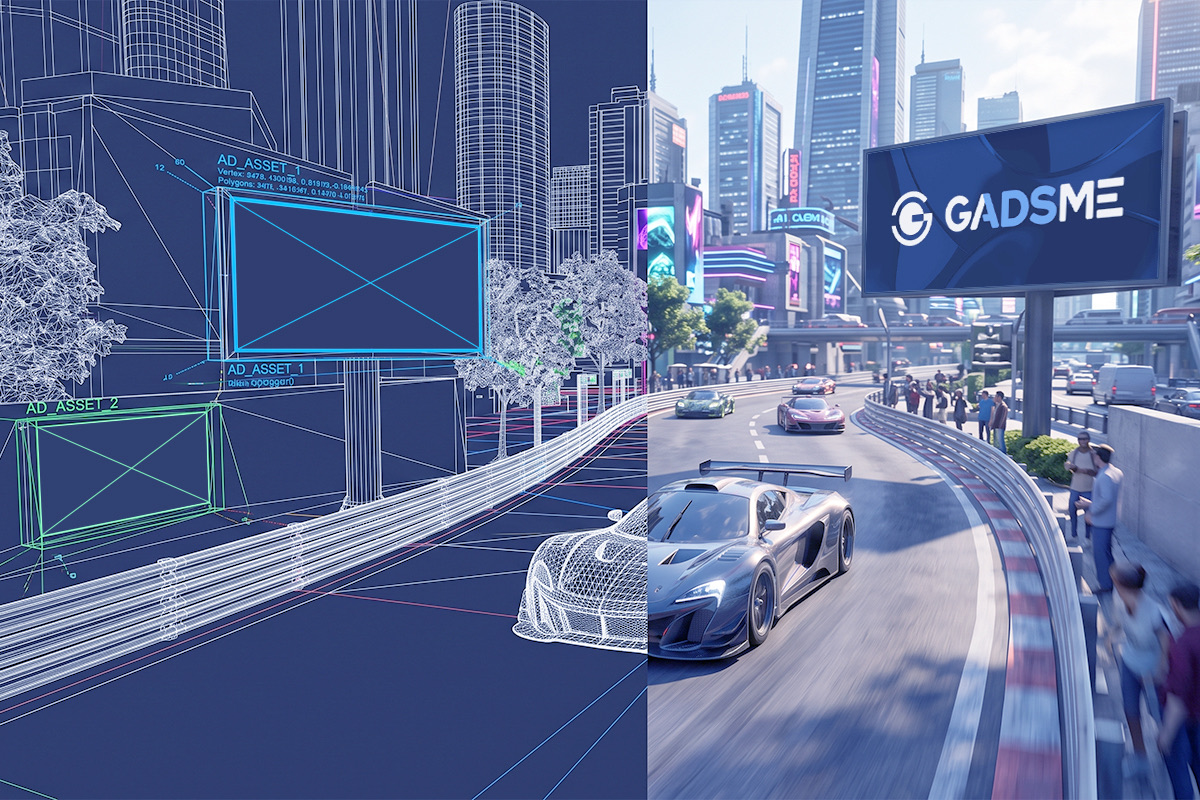
A technical overview of how modern intrinsic in-game advertising platforms integrate ads without breaking gameplay, performance, or immersion.
In-game advertising is often compared to web or mobile advertising. That comparison is misleading.
Unlike websites or apps, video games operate inside a real-time rendering loop where performance constraints are unforgiving. Every additional process competes with gameplay itself. If advertising disrupts that balance, players notice immediately.
Understanding how intrinsic in-game advertising works requires understanding where it lives technically: inside the rendering pipeline, not above it.
This article explains how modern intrinsic in-game advertising platforms integrate ads at the rendering level, why this approach differs fundamentally from traditional digital advertising, and what technical constraints shape what is possible.
Why in-game advertising is technically different
Web and mobile ads run in document-based environments. Pages load, elements stack, scripts execute, and performance is amortized over time. A dropped frame on a website is rarely noticeable.
Games are different. They run continuous loops that must maintain stable frame rates, often 30 or 60 frames per second. Every frame has a strict time budget. Miss it, and the experience degrades instantly.
Intrinsic in-game advertising operates inside this real-time loop. It cannot rely on browser concepts, overlays, or delayed execution. Any advertising system must respect the same constraints as core gameplay systems: rendering, physics, input, and audio.
This is why many approaches that work in other digital channels fail in games.
A simplified view of the game rendering pipeline
At a high level, most games follow a recurring loop:
- process player input
- update game state (physics, AI, logic)
- render the frame (geometry, textures, lighting, shaders)
- display the frame
- repeat
Advertising assets that appear in-game must be resolved during the rendering phase. They are not inserted after the fact. They are drawn as part of the frame itself.
Textures, meshes, materials, lighting, and camera perspective all interact. If an advertising asset does not behave like a native game asset, it breaks immersion immediately.
This is the core challenge of intrinsic in-game advertising.
What rendering-level integration actually means
Rendering-level integration means that ads are treated as native visual assets, not UI elements layered on top of gameplay.
In practice, this involves predefined ad surfaces created by the game developer. These surfaces exist in the game world like any other object: a billboard, a stadium banner, a poster, or a digital screen.
At runtime, the advertising system dynamically replaces placeholder textures on those surfaces with advertiser creatives. The ad is rendered using the same pipeline as the rest of the scene. It respects lighting, perspective, distance, occlusion, and camera movement.
There is no overlay, no interruption, no UI takeover. From the player's perspective, the ad is simply part of the environment.
This approach fundamentally differs from interstitials, banners, or rewarded videos, which interrupt gameplay flow or sit outside the game world. See what is in-game advertising for how these formats compare.
How ad content is delivered without patching the game
Modern intrinsic in-game advertising platforms separate game logic from ad content.
During development, the game includes placeholder assets for ad surfaces. These placeholders define where ads can appear and how they behave visually. The game ships once with those surfaces embedded.
At runtime, the advertising SDK fetches creative assets from an ad server and swaps them into the placeholders dynamically. This happens without requiring a game update or app store resubmission.
Different players can see different ads in the same game session. Campaigns can start, stop, or change without touching the game build.
This architecture allows advertising to behave like live content while preserving the stability of the game itself.
Performance constraints and why FPS matters
Performance is the non-negotiable constraint in game development.
Advertising systems must operate within tight CPU, GPU, and memory budgets. Excessive texture sizes, blocking network calls, or inefficient rendering logic directly impact frame rate.
A drop from 60 FPS to 55 FPS may be invisible on a web page. In a game, it feels like lag.
For this reason, well-designed SDKs are lightweight, asynchronous, and optimized for mobile hardware. Asset loading is controlled. Fallbacks exist. Failure states are handled gracefully.
Any advertising system that impacts frame rate will fail at scale, regardless of revenue potential. This is one of the first things developers should check when evaluating a monetization partner.
How player state is preserved during interactions
Interactive advertising introduces additional complexity.
When a player interacts with an in-game ad, the game must temporarily transition out of active play. This can involve pausing the game loop or backgrounding the application while preserving the full game state.
Position, progress, timers, and session data must remain intact. When the player returns, the game must resume exactly where it left off.
This state preservation is trivial in theory and difficult in practice. It requires careful coordination between the game engine, the operating system, and the advertising SDK.
Poor implementations lead to lost progress, crashes, or forced restarts. Good implementations are invisible to the player.
Measurement inside games is not web measurement
Measurement in games cannot rely on scroll depth, DOM visibility, or viewport assumptions.
In-game exposure depends on gameplay context. Camera angle, distance, duration on screen, and player movement all matter. An ad might be technically rendered but never meaningfully seen.
Modern in-game measurement ties exposure to gameplay logic rather than page logic. Metrics consider whether an ad was within the camera frustum, how long it remained visible, and how players interacted with the environment.
In-game measurement is behavioral and spatial. It reflects how players actually experience content, not how pages load.
Why ad blockers and traditional fraud models do not apply
Intrinsic in-game advertising does not operate in a browser. There is no DOM, no JavaScript injection, and no third-party tags executing on arbitrary pages.
Ads are rendered inside closed environments. Inventory is finite and curated. Games are reviewed before onboarding. Placements are predefined by developers.
This eliminates many of the fraud vectors common to open web advertising. Bot traffic, hidden placements, and domain spoofing are structurally harder to execute in games.
Fraud prevention in gaming relies more on inventory control and human QA than on reactive filtering. See brand safety for how Gadsme handles this.
Common technical misconceptions
Several misconceptions persist:
- "In-game ads are just images." In reality, they are real-time rendered assets governed by the game engine.
- "You can add advertising at the end of development." Poorly planned placement often results in unnatural or disruptive integration.
- "Performance impact is negligible." Even small inefficiencies compound across frames.
- "Measurement works like web display." Game contexts require different exposure models.
These misconceptions explain why many early in-game advertising attempts failed.
What this architecture enables
Understanding the technical foundation explains why intrinsic in-game advertising behaves differently from any other digital channel.
Rendering-level integration enables non-intrusive monetization for developers, realistic brand integration for advertisers, and measurable interaction without sacrificing gameplay quality.
It also explains why in-game advertising cannot be treated as a simple extension of mobile or web media. The technology shapes the medium.
Want to see it running in your game? Talk to our team.